What “Maharaja Seat” Actually Means
Somewhere in the last few years, “Maharaja seat” turned into one of the most misused terms in the Jaipur tempo traveller market. Operators use it loosely, photos get recycled across listings, and by the time a family is comparing quotes, half of them say “Maharaja seating” without anyone agreeing on what that actually is.
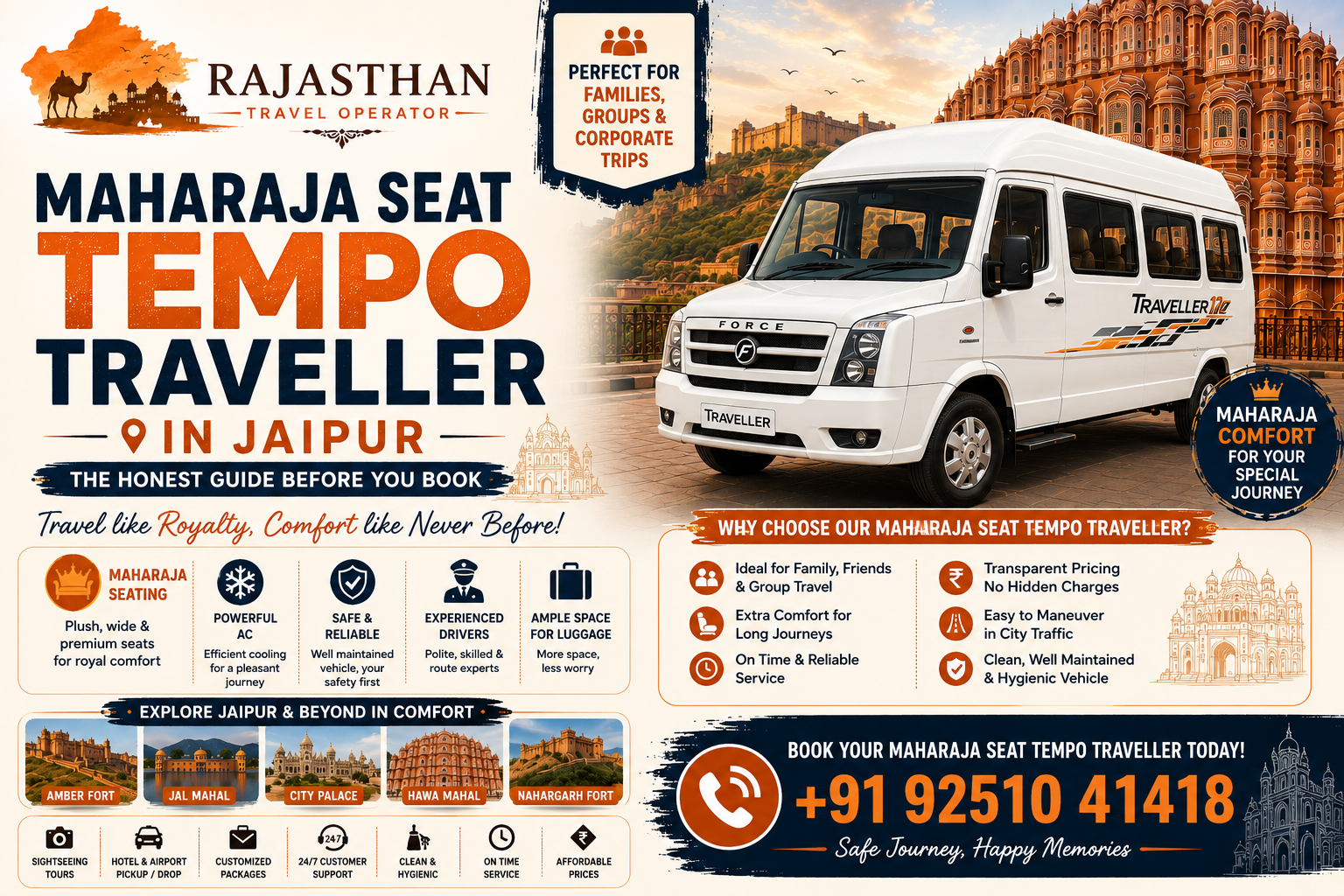
Here’s the plain version. A Maharaja seat isn’t a brand or a fixed spec — it’s a seating configuration. Instead of standard 2×2 or 3-across rows packed tight down the aisle, the vehicle is fitted with fewer, wider individual chairs, usually with armrests on both sides, more distance between rows, and enough width that two adults aren’t sharing elbow room. It trades headcount for space. A body that would normally seat sixteen in standard rows might carry nine or ten in a Maharaja configuration — same vehicle, fewer people, a lot more room per person.
That’s the whole idea. It’s not about branding or luxury trim by itself. It’s about how the seats are laid out inside the cabin.
Why People Actually Book It
Most families don’t book Maharaja seating because they read a spec sheet — they book it because someone in the group can’t do a long day in a cramped row. A parent with a bad back. An elderly grandparent who needs to stretch a leg out, not fold it under a seat in front. A honeymoon or anniversary trip where the whole point is comfort, not just transport. A small group that’s decided the trip matters more than the per-seat price.
It also solves a specific, very common Rajasthan problem: long highway days. Jaipur to Udaipur or Jodhpur is a six-to-seven-hour stretch, and the difference between a standard row and a Maharaja chair isn’t dramatic for the first hour — it’s dramatic by hour five, when everyone else is shifting in their seat and your group is still comfortable.
Which Vehicles Actually Offer It
This is where people get caught out, because Maharaja seating and vehicle type are two separate decisions that get bundled together in marketing but aren’t actually the same thing.
Standard tempo traveller bodies — the ladder-frame vehicles used across the 10 seater, 12 seater, and 16 seater range — can be fitted with Maharaja chairs instead of standard rows. You keep the roof carrier advantage of the standard chassis, and you get the wider seating on top. This is often the more practical combination for a multi-day trip with real luggage, since the boot and roof space don’t disappear just because the seats changed.
Urbania platforms also offer Maharaja configurations, most commonly seen on the 9 seater Urbania with Maharaja seats — widely considered one of the most comfortable small-group options in the entire Jaipur fleet. The ride quality on the monocoque body is better than any standard tempo traveller, and paired with individual reclining chairs, it’s genuinely a different travel experience. The trade-off is the same one that runs through every Urbania tempo traveller booking: no roof carrier, so all luggage travels inside the cabin, and with fewer seats given up to spacing, there’s less room to compromise on bag count.
Ask which chassis your Maharaja seating sits inside before you book anything. “Maharaja seat tempo traveller” alone doesn’t tell you if you’re getting a roof carrier or not, and that single fact changes what your group can actually pack.
The Seat Count Trade-Off
This is the part that surprises first-time bookers most: Maharaja seating always means fewer total seats than the body’s maximum, because the whole point is giving each passenger more space. A body that seats sixteen or seventeen people in standard configuration typically drops to nine, ten, or twelve seats in a Maharaja layout, depending on how wide the chairs are and how much legroom is built in.
This means Maharaja seating almost never makes sense for a large group trying to save money — it’s the opposite trade. You’re paying a comparable or higher rate for fewer seats, in exchange for real comfort. For a big family or event group, a standard 16 seater tempo traveller or larger will always be the cheaper way to move the same number of people. Maharaja seating earns its price when the group is small enough that the extra space actually gets used by everyone, not just a few passengers up front.
Who Should Book It — and Who Shouldn’t
Book it for a small family or couple’s trip where comfort is the actual priority — a honeymoon circuit, an anniversary trip, a parents’ pilgrimage where nobody wants to fold into a tight row for six hours.
Book it when someone in the group has a real physical reason to need more space — a bad back, a knee that doesn’t bend well, a senior citizen who struggles to twist sideways past other passengers.
Book it for a small premium group booking — a corporate delegation, a family that’s decided this particular trip is worth spending more on, or anyone who’s done a cramped row trip before and doesn’t want to repeat it.
Think twice if the group is large and the budget matters. Paying a Maharaja-tier rate for fewer seats than you need means either splitting into two vehicles or leaving people behind — neither is the point of booking a group vehicle in the first place.
Think twice if the trip is short and local. For a half-day city circuit in Jaipur with no long highway stretch, the comfort gap between standard and Maharaja seating is much smaller, and it may not be worth the price difference.
Skip it if what you actually need is a roof carrier for heavy luggage on the Urbania platform — Maharaja seating and roof carrier availability are two different questions, and if bags are the priority, a standard tempo traveller body in Maharaja configuration is almost always the better fit than the Urbania version.
The Routes Where It Earns Its Keep
Jaipur–Udaipur and Jaipur–Jodhpur. Six to seven hours where seat width and recline actually change how the trip feels, especially for older passengers or anyone prone to stiffness on long drives.
Jaipur–Jaisalmer. One of the longest single-day stretches in the state. If comfort was ever going to matter on a Rajasthan route, this is the one.
The Golden Triangle at a relaxed pace. Jaipur–Agra–Delhi, especially for a couple or small group who’d rather spend on comfort than squeeze more people into the vehicle.
Ranthambore and Pushkar weekends. Shorter runs, but a good fit for a small group that’s booked Maharaja seating for the whole trip and wants the comfort to carry through every leg, not just the long ones.
Before You Book — Five Things in Writing
Confirm the exact seat count in the Maharaja configuration. Ask how many chairs, not just “Maharaja seating available” — the number varies a lot between fleets and directly affects your per-seat cost.
Ask which chassis it’s built on. Standard tempo traveller with roof carrier, or Urbania without one. This single answer decides your luggage plan.
Confirm the AC type. Roof-mounted AC versus dashboard blower matters just as much in a Maharaja layout as anywhere else — check it directly, and if you’re comparing against the top-tier option, look at what a luxury Urbania tempo traveller includes by comparison.
Get the per-seat cost, not just the vehicle total. Since Maharaja seating trades headcount for space, comparing the total price against a standard vehicle without adjusting for seat count will make it look more expensive than it needs to.
One all-inclusive number in writing. Base rental, driver allowance, tolls, permits, night halt — same rule as every other booking. Get it all in one WhatsApp message before you commit.
Frequently Asked Questions
What exactly is a Maharaja seat tempo traveller? It’s not a separate vehicle model — it’s a seating configuration with fewer, wider individual chairs and more space between rows, fitted inside either a standard tempo traveller or an Urbania body.
How many people fit in a Maharaja seat tempo traveller? It depends on the chassis and the specific layout, typically nine to twelve passengers rather than the vehicle’s full standard capacity — ask for the exact seat count for the specific vehicle being quoted.
Does a Maharaja seat vehicle have a roof carrier? Only if it’s built on a standard tempo traveller chassis. The Urbania version with Maharaja seating does not take a roof carrier — confirm which chassis you’re booking before you finalise luggage plans.
Is Maharaja seating worth the extra cost? For a small group where comfort on long highway stretches genuinely matters — elderly passengers, honeymoon trips, anyone who’s done a cramped ride before — yes. For a large group focused on cost per seat, a standard configuration on the tempo traveller on rent page will usually make more sense.
How early should I book a Maharaja seat tempo traveller in Jaipur? Five to seven days ahead in normal season, since fewer vehicles in the fleet carry this configuration compared to standard seating. Around wedding muhurats, Diwali, and the Pushkar fair window, book ten days out — these vehicles get committed early.
Final Word
Maharaja seating isn’t a marketing label worth chasing on its own — it’s a genuine trade-off between space and headcount, and it only makes sense once you know which chassis it’s sitting in and how many chairs you’re actually getting. Get that clear, and it’s one of the most comfortable ways to travel Rajasthan for a small group; get it wrong, and you’ve paid a premium rate for a vehicle that doesn’t fit your group or your luggage.
So ask for the exact seat count, confirm the chassis and roof carrier situation, check the AC type, and get one all-inclusive number in writing before you commit. That’s the whole checklist, and it’s the difference between booking real comfort and just booking a name.